
Лекция Тесты Найди пару 18 мин.
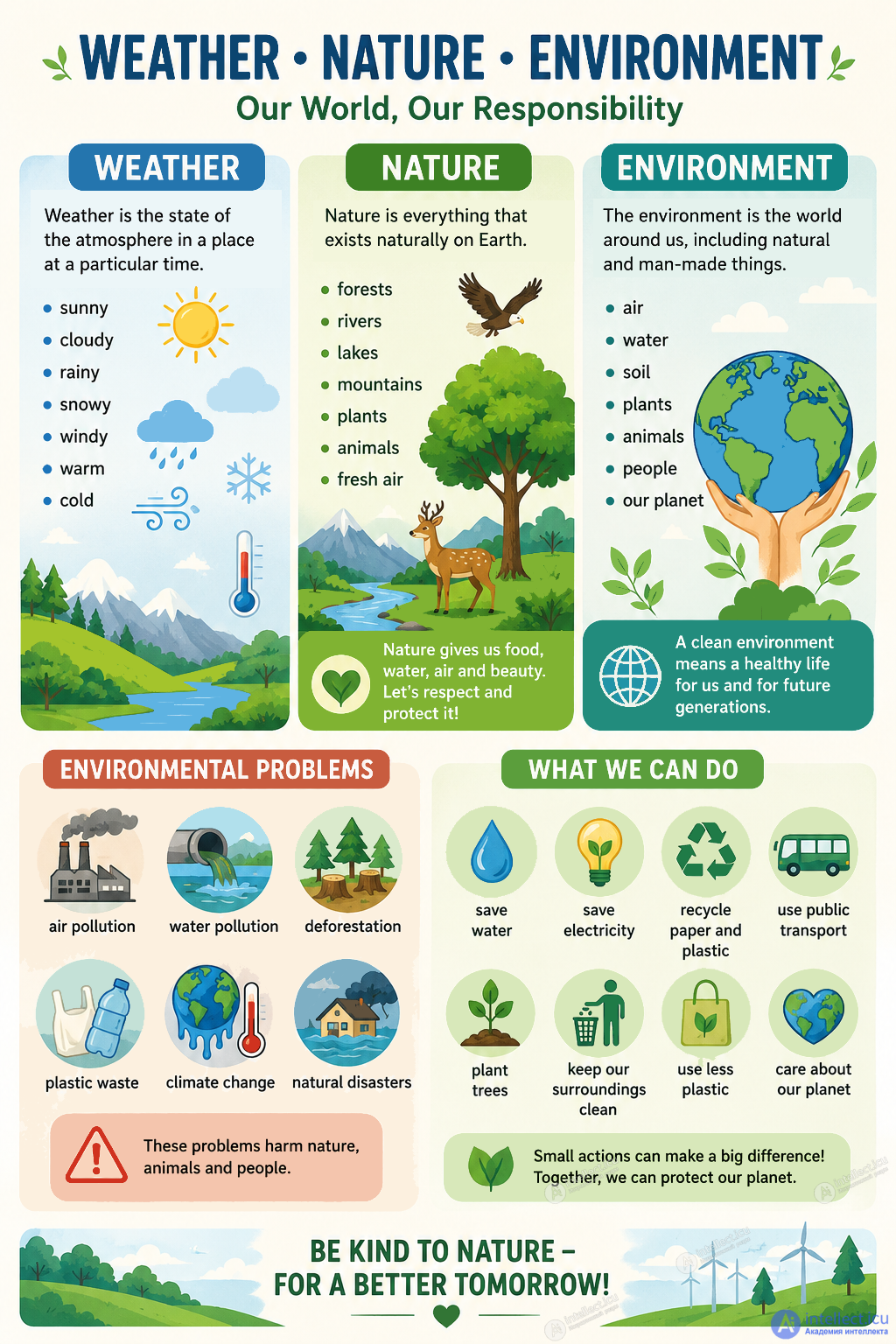
Weather is an important part of our everyday life.
It can be sunny, cloudy, rainy, snowy or windy. In summer, the weather is usually warm and sunny, while in winter it can be cold and snowy.
In spring, nature becomes green and beautiful, and in autumn the leaves turn yellow, orange and red.
Nature is all around us. It includes forests, rivers, lakes, mountains, animals and plants.
Many people enjoy spending time in nature because it helps them relax and feel happy.
We should respect nature and take care of it.
The environment is the world around us. Unfortunately, people can harm the environment in many ways.
Air and water pollution, plastic waste and cutting down forests are serious problems.
Climate change is also affecting our planet.
Temperatures are rising, and some natural disasters are becoming more common.
Everyone can help protect the environment.
We can save water and electricity, recycle paper and plastic, use public transport and plant trees.
We should not throw rubbish on the ground or pollute rivers and lakes.
If people work together, they can make the Earth cleaner, safer and more beautiful.
Protecting nature is important not only for us, but also for future generations.
Погода — важная часть нашей повседневной жизни. Она может быть солнечной, облачной, дождливой, снежной или ветреной. Летом погода обычно теплая и солнечная, а зимой может быть холодно и снежно. Весной природа становится зеленой и красивой, а осенью листья становятся желтыми, оранжевыми и красными.
Природа окружает нас повсюду. Она включает леса, реки, озера, горы, животных и растения. Многие люди любят проводить время на природе, потому что это помогает им расслабиться и чувствовать себя счастливыми. Мы должны уважать природу и заботиться о ней.
Окружающая среда — это мир, который нас окружает. К сожалению, люди могут наносить вред окружающей среде разными способами. Загрязнение воздуха и воды, пластиковые отходы и вырубка лесов — это серьезные проблемы. Изменение климата также влияет на нашу планету. Температура повышается, а некоторые стихийные бедствия становятся более частыми.
Каждый человек может помочь защитить окружающую среду. Мы можем экономить воду и электричество, перерабатывать бумагу и пластик, пользоваться общественным транспортом и сажать деревья. Мы не должны бросать мусор на землю или загрязнять реки и озера.
Если люди будут работать вместе, они смогут сделать Землю чище, безопаснее и красивее. Защита природы важна не только для нас, но и для будущих поколений.
| English expression | Дословно | Перевод |
|---|---|---|
| It’s raining cats and dogs. | Идет дождь из кошек и собак. | Льет как из ведра. |
| It’s a bit nippy. | Немного кусачая погода. | Прохладно / холодновато. |
| Under the weather | Под погодой | Плохо себя чувствовать, быть не в форме. |
| Come rain or shine | Будь дождь или солнце | Несмотря ни на что; в любом случае. |
| A storm in a teacup | Буря в чашке | Буря в стакане воды. |
| Every cloud has a silver lining. | У каждого облака есть серебряная кайма. | Нет худа без добра. |
| Save it for a rainy day. | Сохрани это для дождливого дня. | Отложи на черный день. |
| Come in from the cold | Войти с холода | Получить признание, поддержку или доступ после периода отстранения. |
| English expression | Дословно | Перевод |
|---|---|---|
| Go with the flow. | Плыть по течению. | Не сопротивляться обстоятельствам; плыть по течению. |
| A breath of fresh air | Глоток свежего воздуха | Что-то новое, приятное, освежающее. |
| The grass is always greener on the other side. | Трава всегда зеленее на другой стороне. | У соседа трава зеленее. |
| Can’t see the forest for the trees. | Не видеть леса из-за деревьев. | Не видеть общей картины из-за мелочей. |
| Barking up the wrong tree | Лаять не на то дерево. | Обращаться не к тому человеку; идти по ложному следу. |
| A fish out of water | Рыба, вынутая из воды. | Чувствовать себя не в своей тарелке. |
| Like two peas in a pod | Как две горошины в стручке. | Как две капли воды; очень похожи. |
| In deep water | В глубокой воде. | Быть в серьезной неприятности. |
| English expression | Дословно | Перевод |
|---|---|---|
| Go green | Стать зеленым | Перейти на экологичный образ жизни. |
| Leave a small footprint. | Оставить маленький след. | Минимизировать вред окружающей среде. |
| Carbon footprint | Углеродный след | Количество выбросов, связанных с деятельностью человека. |
| Reduce, reuse, recycle. | Сократи, используй снова, переработай. | Три основных принципа экологичного потребления. |
| Think globally, act locally. | Думай глобально, действуй локально. | Решать глобальные проблемы через конкретные действия на местном уровне. |
| Do your bit for the planet. | Сделать свою часть для планеты. | Внести свой вклад в защиту природы. |
| A drop in the ocean | Капля в океане | Капля в море; очень маленький вклад/количество. |
| Mother Nature | Мать-природа | Природа как живая сила. |
1. выпишите незнакомые слова и их переводы
2. придумайте предложения с новыми неизвестными словами и выражениями
3. перескажите текст по данной теме
[[remember_en]]
[[audition_en]]
[[m1 Weather ]] [[m1 Climate ]]
[[m2 Sunny ]] [[m2 Bright ]]
[[m3 Cloudy ]] [[m3 Overcast ]]
[[m4 Rainy ]] [[m4 Wet ]]
[[m5 Windy ]] [[m5 Breezy ]]
[[m6 Cold ]] [[m6 Chilly ]]
[[m7 Hot ]] [[m7 Warm ]]
[[m8 Storm ]] [[m8 Thunderstorm ]]
[[m9 Rain ]] [[m9 Precipitation ]]
[[m10 Snow ]] [[m10 Snowfall ]]
[[m11 Fog ]] [[m11 Mist ]]
[[m12 Forest ]] [[m12 Woodland ]]
[[m13 Nature ]] [[m13 Wildlife ]]
[[m14 Mountain ]] [[m14 Highland ]]
[[m15 River ]] [[m15 Stream ]]
1. What do we call weather with a lot of sunshine?
Hint: Sunny weather means that the sun is shining.
2. What does “It’s raining cats and dogs” mean?
Hint: This is an idiom meaning that it is raining a lot.
3. What do we call frozen water that falls from the sky?
Hint: Snow consists of ice crystals.
4. What is the opposite of “hot” when we talk about weather?
Hint: Cold means having a low temperature.
5. What does “under the weather” mean?
Hint: This idiom describes someone who is feeling unwell.
6. Which season comes after winter?
Hint: In this season, plants begin to grow and flowers appear.
7. What happens to many leaves in autumn?
Hint: Autumn is famous for colorful leaves.
8. What is a “forest”?
Hint: Forests are natural areas where many trees and plants grow.
9. Which of these is a natural source of water?
Hint: Rivers carry water through the land.
10. What does the expression “go with the flow” mean?
Hint: The expression comes from the idea of moving naturally with a river.
11. What is an “environment”?
Hint: The environment includes air, water, land, plants, animals and people.
12. Which problem is caused by harmful substances in the air?
Hint: Smoke and harmful gases can pollute the air.
13. What is “water pollution”?
Hint: Pollution makes water harmful to people, animals or plants.
14. What does “deforestation” mean?
Hint: Deforestation means removing forests, often by cutting down trees.
15. Which of these is an example of plastic waste?
Hint: Plastic bottles and bags can become waste if they are thrown away.
16. What should we do with paper and plastic when possible?
Hint: Recycling helps reduce the amount of waste.
17. What does “go green” mean?
Hint: “Go green” means to choose actions that are better for the environment.
18. What is a “carbon footprint”?
Hint: A carbon footprint is connected with greenhouse gas emissions.
19. Which action can help save water?
Hint: Using only the water we need helps conserve this resource.
20. Which form of transport is generally more environmentally friendly than using a private car alone?
Hint: Buses and trains can carry many people at the same time.
21. What does “a breath of fresh air” mean?
Hint: This expression can describe a refreshing person, idea or experience.
22. What does “The grass is always greener on the other side” mean?
Hint: This idiom describes the tendency to think that other people have a better situation.
23. What does “You can’t see the forest for the trees” mean?
Hint: The expression contrasts individual details with the whole situation.
24. Which of these is a renewable source of energy?
Hint: Wind is naturally replenished and can be used to produce electricity.
25. What is climate change?
Hint: Climate change refers to long-term changes, not just daily weather.
26. Which action is best for protecting forests?
Hint: Trees are important for ecosystems and help support biodiversity.
27. What does “do your bit for the planet” mean?
Hint: “Do your bit” means to make your own contribution.
28. What does “a drop in the ocean” describe?
Hint: One small drop is tiny compared with the size of an ocean.
29. Which sentence describes a responsible environmental action?
Hint: Reducing waste and recycling help protect the environment.
30. Why is it important to protect nature?
Hint: People, animals and plants all depend on healthy ecosystems.

Комментарии