
Лекция Тесты Найди пару 16 мин.
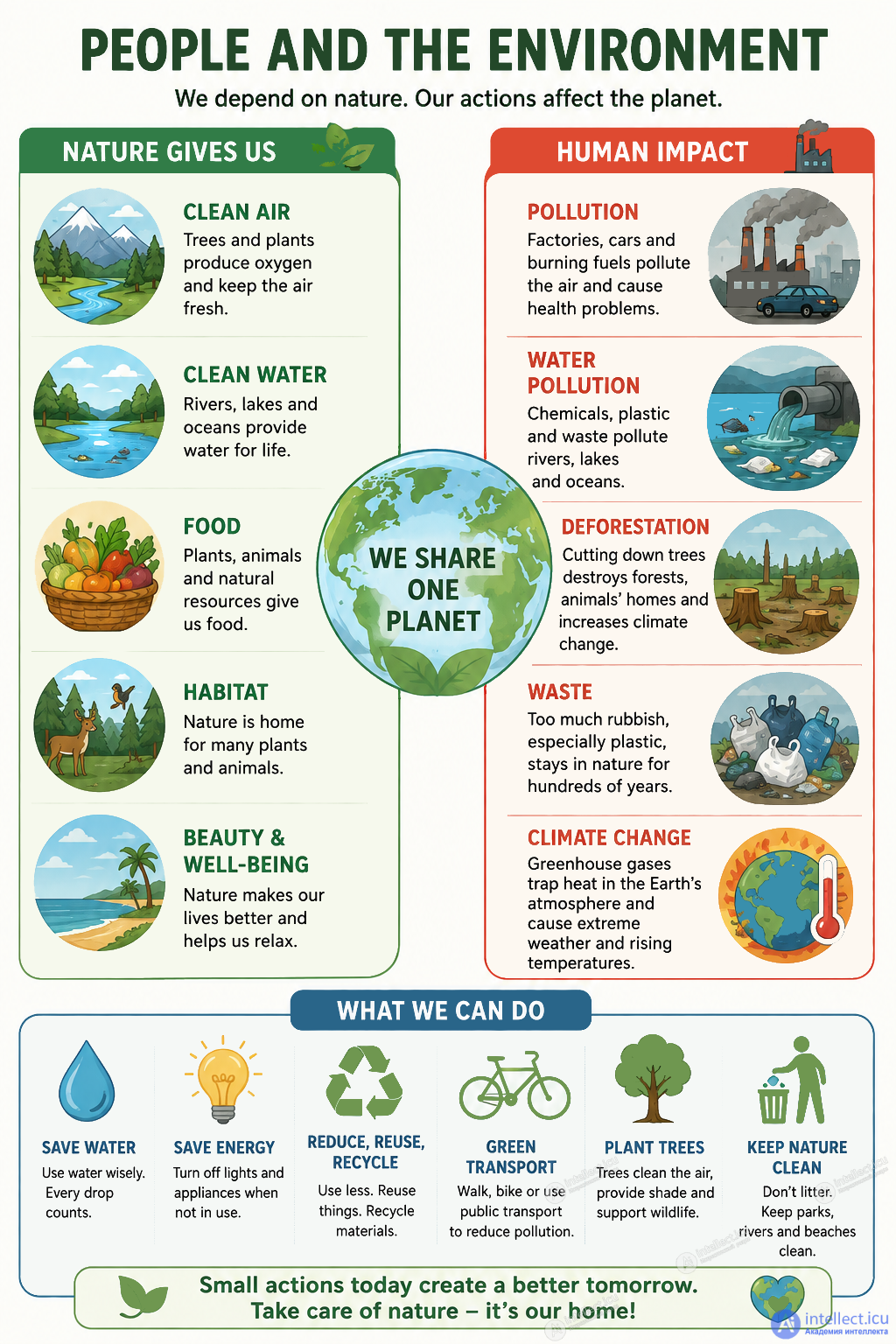
People and the environment are closely connected.
We need nature because it gives us air, water, food and many other things.
Forests, rivers, lakes and oceans are very important for life on Earth.
However, people often harm the environment.
We produce a lot of rubbish, pollute the air and water, and cut down forests.
Cars and factories produce harmful gases that can cause climate change.
Plastic pollution is also a serious problem because plastic can stay in nature for hundreds of years.
There are many ways to protect our planet.
We can save water and electricity, use less plastic, recycle rubbish and use public transport or bicycles.
People can also plant trees and keep parks, forests and rivers clean.
Everyone can help the environment.
Even small actions can make a difference.
If people take care of nature today, future generations will have a cleaner and healthier planet.
Человек и окружающая среда тесно связаны. Нам нужна природа, потому что она дает нам воздух, воду, пищу и многие другие вещи. Леса, реки, озера и океаны очень важны для жизни на Земле.
Однако люди часто наносят вред окружающей среде. Мы производим много мусора, загрязняем воздух и воду и вырубаем леса. Автомобили и фабрики выделяют вредные газы, которые могут вызывать изменение климата. Загрязнение пластиком также является серьезной проблемой, потому что пластик может оставаться в природе сотни лет.
Существует много способов защитить нашу планету. Мы можем экономить воду и электричество, использовать меньше пластика, перерабатывать мусор и пользоваться общественным транспортом или велосипедами. Люди также могут сажать деревья и содержать парки, леса и реки в чистоте.
Каждый человек может помочь окружающей среде. Даже небольшие действия могут изменить ситуацию к лучшему. Если люди будут заботиться о природе сегодня, будущие поколения получат более чистую и здоровую планету.
| English expression | Дословно | Перевод / значение |
|---|---|---|
| to go green | пойти зеленым | перейти на экологичный образ жизни |
| to do one's bit for the environment | сделать свою часть для окружающей среды | внести свой вклад в защиту природы |
| to leave a smaller footprint | оставить меньший след | уменьшить воздействие на окружающую среду |
| carbon footprint | углеродный след | количество выбросов, связанных с деятельностью человека |
| to live off the land | жить с земли | жить за счет природных ресурсов |
| to live in harmony with nature | жить в гармонии с природой | жить в согласии с природой |
| to be at one with nature | быть одним с природой | чувствовать единство с природой |
| to tread lightly on the Earth | легко ступать по Земле | бережно относиться к природе |
| to give back to nature | вернуть природе | компенсировать вред, помогать природе |
| to cut down on waste | сократить вниз на отходы | уменьшить количество отходов |
| to make a difference | сделать разницу | изменить ситуацию к лучшему |
| to make the world a better place | сделать мир лучшим местом | сделать мир лучше |
| to be environmentally friendly | быть дружественным окружающей среде | быть экологичным |
| to do more harm than good | сделать больше вреда, чем пользы | принести больше вреда, чем пользы |
| to be a drop in the ocean | быть каплей в океане | быть очень малой частью проблемы/решения |
1. To go green
More and more people are trying to go green and reduce their use of plastic.
Все больше людей стараются вести экологичный образ жизни и уменьшать использование пластика.
2. To do one's bit for the environment
Everyone can do their bit for the environment by recycling and saving water.
Каждый может внести свой вклад в защиту окружающей среды, перерабатывая отходы и экономя воду.
3. To tread lightly on the Earth
We should tread lightly on the Earth and use natural resources responsibly.
Мы должны бережно относиться к планете и ответственно использовать природные ресурсы.
4. To make a difference
Even small actions can make a difference.
Даже небольшие действия могут изменить ситуацию к лучшему.
5. To cut down on waste
We need to cut down on waste and reuse things whenever possible.
Нам нужно сократить количество отходов и по возможности использовать вещи повторно.
6. To be a drop in the ocean
One person recycling may seem like a drop in the ocean, but millions of people can make a difference.
Переработка отходов одним человеком может показаться каплей в море, но миллионы людей способны изменить ситуацию.
Полезная фраза:
Small actions can make a big difference. If we all do our bit for the environment, we can make the world a better place.
[[remember_en]]
[[audition_en]]
[[m1 Environment ]] [[m1 Natural world ]]
[[m2 Nature ]] [[m2 Wildlife ]]
[[m3 Pollution ]] [[m3 Contamination ]]
[[m4 Waste ]] [[m4 Rubbish ]]
[[m5 Garbage ]] [[m5 Trash ]]
[[m6 Clean air ]] [[m6 Fresh air ]]
[[m7 Clean water ]] [[m7 Fresh water ]]
[[m8 Deforestation ]] [[m8 Forest destruction ]]
[[m9 Climate change ]] [[m9 Global warming ]]
[[m10 Greenhouse gases ]] [[m10 Heat-trapping gases ]]
[[m11 Carbon footprint ]] [[m11 Environmental impact ]]
[[m12 Renewable energy ]] [[m12 Clean energy ]]
[[m13 Solar energy ]] [[m13 Solar power ]]
[[m14 Wind energy ]] [[m14 Wind power ]]
[[m15 Recycling ]] [[m15 Waste processing ]]
1. What does the expression “to go green” mean?
Hint: Go green means to change your lifestyle to protect the environment.
2. What do trees produce that people need to breathe?
Hint: Trees and plants produce oxygen.
3. What is a “carbon footprint”?
Hint: A carbon footprint is connected with greenhouse gas emissions.
4. Which activity causes deforestation?
Hint: Deforestation means destroying forests, often by cutting down trees.
5. What does “to cut down on waste” mean?
Hint: Cut down on means reduce.
6. Which of these is a renewable source of energy?
Hint: Solar energy comes from the Sun and can be naturally renewed.
7. What is water pollution?
Hint: Pollution means making the environment dirty or harmful.
8. Which action helps reduce plastic pollution?
Hint: Reusable products can reduce the amount of plastic waste.
9. What does “to do one's bit for the environment” mean?
Hint: Do one's bit means to make one's own contribution.
10. Which transport is usually considered environmentally friendly?
Hint: Bicycles do not produce exhaust emissions.
11. What is climate change?
Hint: Climate change refers to long-term changes in temperature and weather patterns.
12. Which word means “the natural world around us”?
Hint: The environment includes air, water, land, plants and animals.
13. What does “to tread lightly on the Earth” mean?
Hint: The expression means to live in a way that causes less harm to nature.
14. Which of these is an example of recycling?
Hint: Recycling means processing used materials so they can be used again.
15. Why are forests important?
Hint: Forests are homes for many animals and plants and help maintain healthy ecosystems.
16. What does “make a difference” mean?
Hint: Make a difference means to have a positive or important effect.
17. Which gas is strongly associated with human-caused climate change?
Hint: Carbon dioxide is an important greenhouse gas.
18. What is a habitat?
Hint: A habitat is the natural home of a plant or animal.
19. Which action saves energy at home?
Hint: Turning off unused lights and appliances helps reduce energy consumption.
20. What does “environmentally friendly” mean?
Hint: Environmentally friendly means causing little or no harm to nature.
21. What is the best way to describe “waste”?
Hint: Waste includes unwanted materials such as rubbish and discarded products.
22. Which activity can help protect wildlife?
Hint: Animals need safe natural habitats to survive.
23. What does “to live in harmony with nature” mean?
Hint: Harmony means peaceful and balanced coexistence.
24. Which of these is a fossil fuel?
Hint: Coal, oil and natural gas are fossil fuels.
25. Why is plastic waste dangerous for oceans?
Hint: Plastic can remain in the environment for a very long time.
26. What does “a drop in the ocean” mean?
Hint: This expression describes something very small in comparison with a much larger situation.
27. Which of these actions can reduce air pollution?
Hint: Public transport can reduce the number of individual vehicles on the roads.
28. What does “give back to nature” mean?
Hint: Give back to nature means to contribute positively to the environment.
29. Which three words describe the basic principles of responsible consumption?
Hint: The three Rs are Reduce, Reuse and Recycle.
30. What is the main message of “People and the Environment”?
Hint: People and nature are closely connected, and everyone can help protect the planet.
Ответы на вопросы для самопроверки пишите в комментариях, мы проверим, или же задавайте свой вопрос по данной теме.

Комментарии