
adj. made, done,et cetera (и так далее), without method or conscious choice. at random without a particular aim. randomize v. (also -ise) (-zing or -sing). randomization n. randomly adv. randomness n. [French randon from randir gallop]

 ... it flows , changes its state only at.times whose number is finite or countable A random process is called a process with continuous time . , if the transition from state to state can ... ... with continuous time . , if the transition from state to state can occur at.any time A random process is called a process with continuous states . if the value of the random process is a continuous .random ... (probabilistic processes)
 ... . In contrast to the numerical characteristics of random variables that. provide certain numbers , the characteristics of random functions are, in.general , not numbers , but functions Expectation of random function is defined as follows Consider ... ... the cross section of a random function with fixed . In this section we have the usual random variable ; we . define its expectation Obviously , in the general case it depends on i e it represents ... (Probability theory. Mathematical Statistics and Stochastic Analysis)
 ... ofn.isolated vertices bysequentially randomly adding edges connecting vertices Thepurpose ofmodeling random graphs istodetermine at.whatstage acertain property ofthegraph appears Different models ofrandom ... ... byHilbert .anddenoted byG ( n , p ), inwhich any possible .edge appears independently withprobability < p < Theprobability ofa.random graph withmedges isequal topm (1 -.p ) N - mThe - Rényimodel [en ] close toit, denoted by.G ( n , M ), gives ... (Probability theory. Mathematical Statistics and Stochastic Analysis)
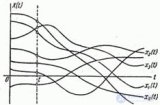 ... ; the deviation . of the trajectory of the controlled projectile from the theoretical .in the process of control or homing Such random variables , which change in the course of experience ., we will, unlike ordinary random variables ... ... manifests . itself in the form of a process , is dealt with.by a special branch of the theory of probability — the theory . of random functions (otherwise , the theory of random or stochastic .processes ) This science can be figuratively ... (Probability theory. Mathematical Statistics and Stochastic Analysis)
 ... equations In this connection , in practice , the application of the described . general methods of linear transformations of random functions , as a.rule , turns out to be too complicated and does not justify . itself In ... ... decomposition , developed . by V S Pugachev , is the content of this chapter The idea of the method of canonical decompositions is that. a random function , over which you need to make certain .transformations , is first represented ... (Probability theory. Mathematical Statistics and Stochastic Analysis)
 ... of the individual variables that.make it up : in addition , they also include interrelations (dependencies ) between . random variables When considering issues related to systems of random variables , it. is convenient to use ... ... variables , it. is convenient to use the geometric interpretation of the system For example , a system of two random variables can be. represented as a random point on a plane with coordinates .and (Fig Similarly , a system ... (Probability theory. Mathematical Statistics and Stochastic Analysis)

Комментарии